Audience-Led Launch (ALL) Framework
What it is
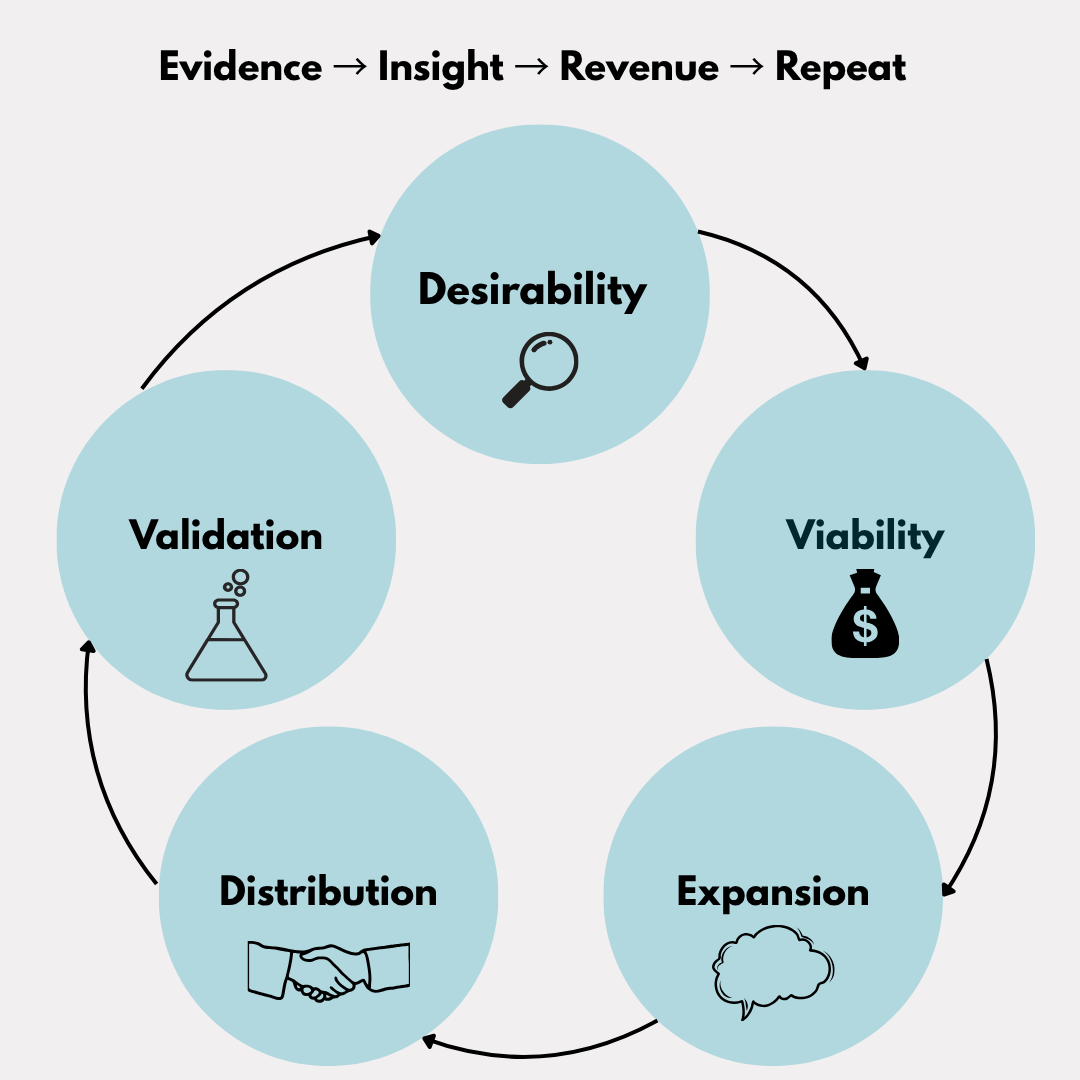
A structured, research-first system for launching and monetizing digital products, especially AI- and creative-tech solutions that combines:
- JTBD discovery,
- Monetization & packaging research, and
- Existing-audience expansion,
all amplified through partner/influencer co-creation and validated by lightweight market experiments.
Purpose
De-risk product launches and unlock revenue by putting audience insight first before building, pricing, or marketing. ALL unifies three research tracks into a single 8–10 week operating system.
Suitable for
The framework is intended for product marketing, growth, and product teams working on subscription, add-on, or hybrid revenue models.
Conceptual Foundation
The ALL Framework builds on established disciplines but combines them into a single, launch-oriented workflow:
- Jobs-to-Be-Done (C. Christensen): to identify real switching moments, desired outcomes, and segments worth monetizing.
- Behavioral economics (D. Kahneman and successors): to prioritize observed behavior and live tests over self-reported preference, and to account for price perception and anchoring in offer design.
- Value-based pricing and packaging (T. Nagle, G. Müller): to derive value metrics, tier fences, and pricing corridors from customer-perceived value rather than from internal cost or competitor mimicry.
This integration is what makes ALL distinct: it treats monetization and distribution as research outputs, not as post-launch activities.
Principles
- Evidence over opinion (interviews → surveys → live tests).
- Distribution is part of the product (partners/creators involved early).
- Launch the smallest bet that proves the biggest question.
- Design price and package around value metrics, not features.
- Start where you already have trust (existing audience), then expand.
Components
1. JTBD Discovery (Desirability)
Goal: Identify high-value problems and outcomes worth building for.
Inputs: Customer interviews (switching moments), support threads, community posts, sales notes.
Methods: JTBD interviews (8–12/segment), pattern coding, opportunity sizing.
Outputs (artefacts):
- Jobs Map (jobs → pains → desired outcomes).
- Opportunity Tree with top 3–5 bet areas.
- Hypothesis briefs (problem, user quote, expected impact, metric).
2. Monetization & Packaging (Viability)
Goal: Remove guesswork from pricing and plan design.
Inputs: Shortlisted benefits/features from JTBD.
Methods:
- Qual pricing interviews (value drivers, willingness cues).
- MaxDiff (prioritize benefits/feature value).
- Van Westendorp/PSM (pricing corridor per segment).
- Live tests when feasible (A/B offer pages, checkouts).
Outputs:
- Value metric + scaling rules (what we charge for, how it grows).
- 3-tier package design with fences (Good/Better/Best or Role/Usage-based).
- Segment-specific price ranges + guardrails (margin, payback, NRR).
3. Existing-Audience Expansion (Grow With Who You Have)
Goal: Create/position offers that your current users convert on quickly.
Approaches:
- Vertical: add-ons, premium service, pro features.
- Horizontal: adjacent products the audience already "hires."
Outputs:
- Audience Potential Matrix (idea × segment × attach-rate × margin).
- Cross-sell playbook (in-product prompts, email flows, success moments).
- Bundle logic (core → add-on → premium ladder).
4. Partner & Influencer Co-Creation (Distribution)
Goal: Use expert creators/partners to both shape and distribute the launch.
Methods:
- Advisory roundtables and closed pilots.
- Decision Matrix with partner signal weighted > user anecdote (e.g., ×1.3).
Outputs:
- Partner-validated idea shortlist.
- Content/launch lanes (reviews, tutorials, workshops, bundles).
5. Experimentation Loop (Validation)
Goal: Prove demand and willingness-to-pay before full build.
Methods:
- Message tests (ad/email/social CTR, click-through to value prop).
- Offer tests (trial length, credits, anchor price).
- Private beta (N=50–200) with partner creators; collect testimonials.
Exit Criteria ("Go" when):
- WTP inside corridor for target segment,
- Beta retention ≥ target, and
- Unit economics clear guardrails (gross margin, infra/AI costs).
6. Governance & Evidence (Repeatability)
Goal: Make the process teachable and auditable.
Artifacts to keep: research plan, interview guides, MaxDiff/PSM instruments, pricing corridors, tier fences, partner matrix, test results, decision log.
Rituals: weekly research stand-up, biweekly decision review, post-launch readout.
Scoring Model (use to pick winners)
Score each idea 1–5 on:
- Desirability: JTBD fit, intensity of pain, partner signal ×1.3.
- Viability: within corridor, margin after variable costs, NRR potential.
- Feasibility: time to MVP, data/tech constraints, dependency risk.
- Distribution: pre-committed partner lanes, audience size/reach.
Sum scores; break ties with distribution readiness and time-to-signal.
Operating Cadence (8–10 weeks)
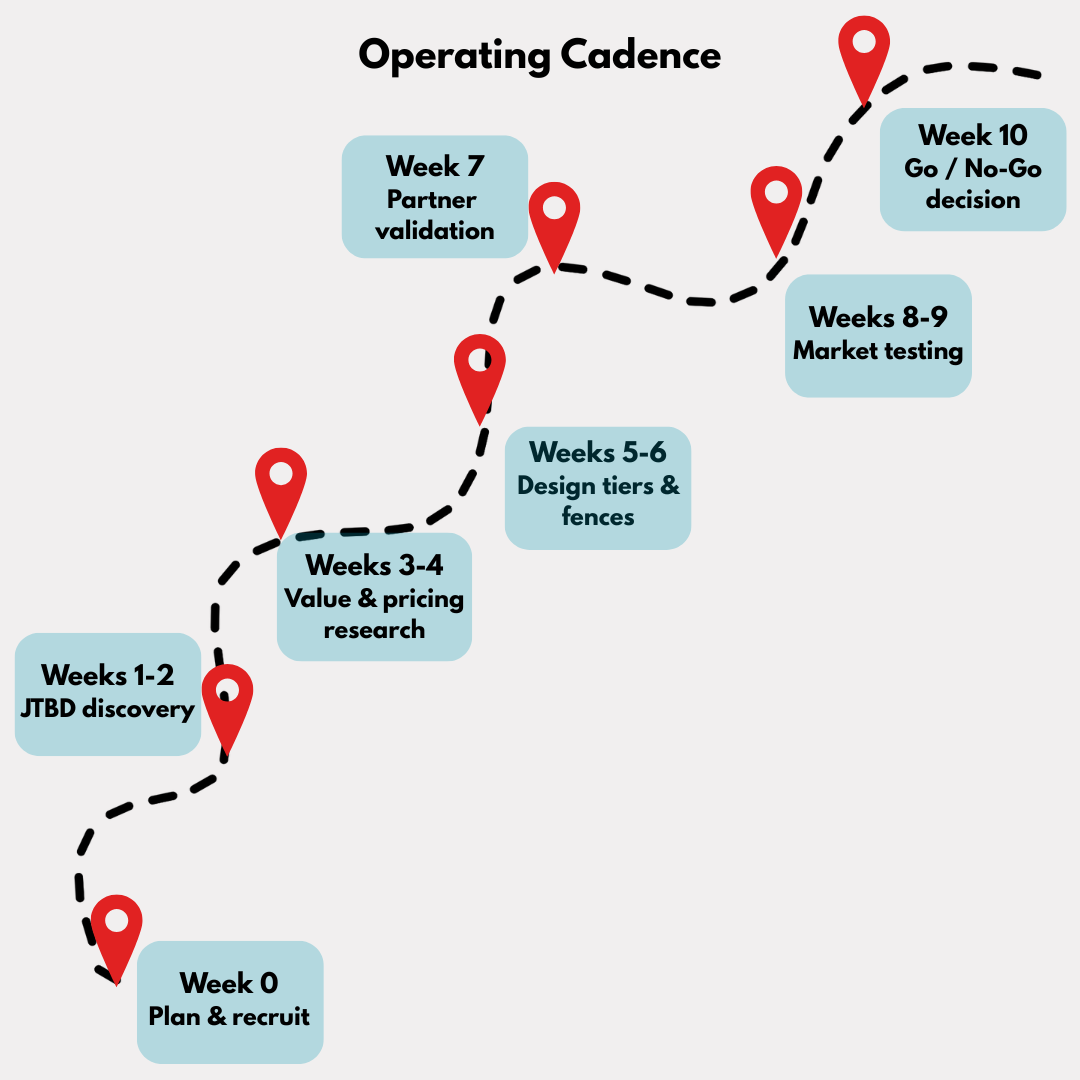
Week 0: Plan & recruit (segments, partners, sample sizes). Weeks 1–2: JTBD discovery (interviews, synthesis). Weeks 3–4: MaxDiff + pricing interviews; draft value metric. Weeks 5–6: PSM/Van Westendorp; design tiers & fences. Week 7: Partner roundtable; finalize shortlist. Weeks 8–9: Message/offer tests; private beta. Week 10: Go/No-Go; lock pricing + launch plan; create assets.
(Compressible to 4–6 weeks for L2/L3 releases; expand for L1.)
Roles & RACI
- PMM (Driver): research plan, surveys, pricing, narrative, launch plan.
- PM (Co-Driver): JTBD synthesis, feasibility, MVP scope.
- Data/UXR: survey design, analysis, instrumentation.
- Sales/CS: recruit segments, surface objections, validate fences.
- Partners/Creators: idea signal, distribution lanes, pilot content.
- Finance/RevOps: guardrails (margin, payback), packaging impact.
KPIs & Benchmarks
- Pre-launch: interview N, MaxDiff clarity (top 5 items ≥65% share), corridor width ≤ ±20% of anchor.
- Beta: D7 retention vs control, task success, NPS with "value for price."
- Launch: conversion lift vs baseline, ARPU vs plan, attach-rate of add-ons.
- Post-30/60/90: NRR by segment/tier, refund rate, time-to-value.
Anti-Patterns (what to avoid)
- Shipping roadmap features without a value metric.
- Pricing by competitor mimicry or cost-plus alone.
- Partner marketing bolted on at the end.
- Surveys without qualitative grounding (or vice versa).
- "One-tier fits all" when segments have distinct jobs.
Templates (use these every time)
- Interview Guide: switching moment, desired outcome, constraints, alternatives.
- Hypothesis Brief: problem → who → expected behavior change → metric.
- MaxDiff List: 12–18 crisp, benefit-led statements (no feature soup).
- Pricing Corridor Sheet: segment, OPP, lower/upper bounds, notes.
- Tier Matrix: value metric, fences, limits, upgrade paths, edge cases.
- Partner Matrix: creator type, reach, credibility, proof assets, lane.
- Decision Log: evidence, decision, owner, date, next test.
How to Use ALL (decision tree)
- Launching net-new: Run full ALL (1→5), lighter partner pass if distribution unknown.
- Extending for existing users: Start at Component 3 → 2 → 5; rely on first-party data and creator pilots.
- Pricing refresh only: Run 2 + 5; pull inputs from recent JTBD work.
Example "Day-1" Checklist
- Define target segments and outcomes.
- Book 12 interviews (mix of heavy/light users + recent switchers).
- Draft 15 MaxDiff items (benefits, not features).
- List 3 plausible value metrics; note data availability.
- Recruit 3 partners/creators for roundtable + pilot.
- Pre-write two offer variants and one message test per segment.
- Align guardrails with Finance (target margin, payback).
Originally developed by Juliana Chyzhova. © 2019 All rights reserved.